Eat & Drink
Cafés & Coffee
Specialty coffee and work-friendly cafés across Chiang Mai.
Living in Chiang Mai
The essentials of remote work in Chiang Mai — the best coworking spaces, genuinely work-friendly cafés in Nimman and Santitham, and how to set up reliable Wi-Fi, SIMs and home internet.
In this section
Day rates, monthly memberships, opening hours, call booths and which crowd each space actually attracts.
The Nimman and Santitham cafés with real power sockets, honest Wi-Fi and no three-hour glare from staff.
SIMs, eSIMs, pocket Wi-Fi and home fibre — what to buy on day one and what to sort out in week two.
Practical notes on running European and US hours from a UTC+7 city without wrecking your week.
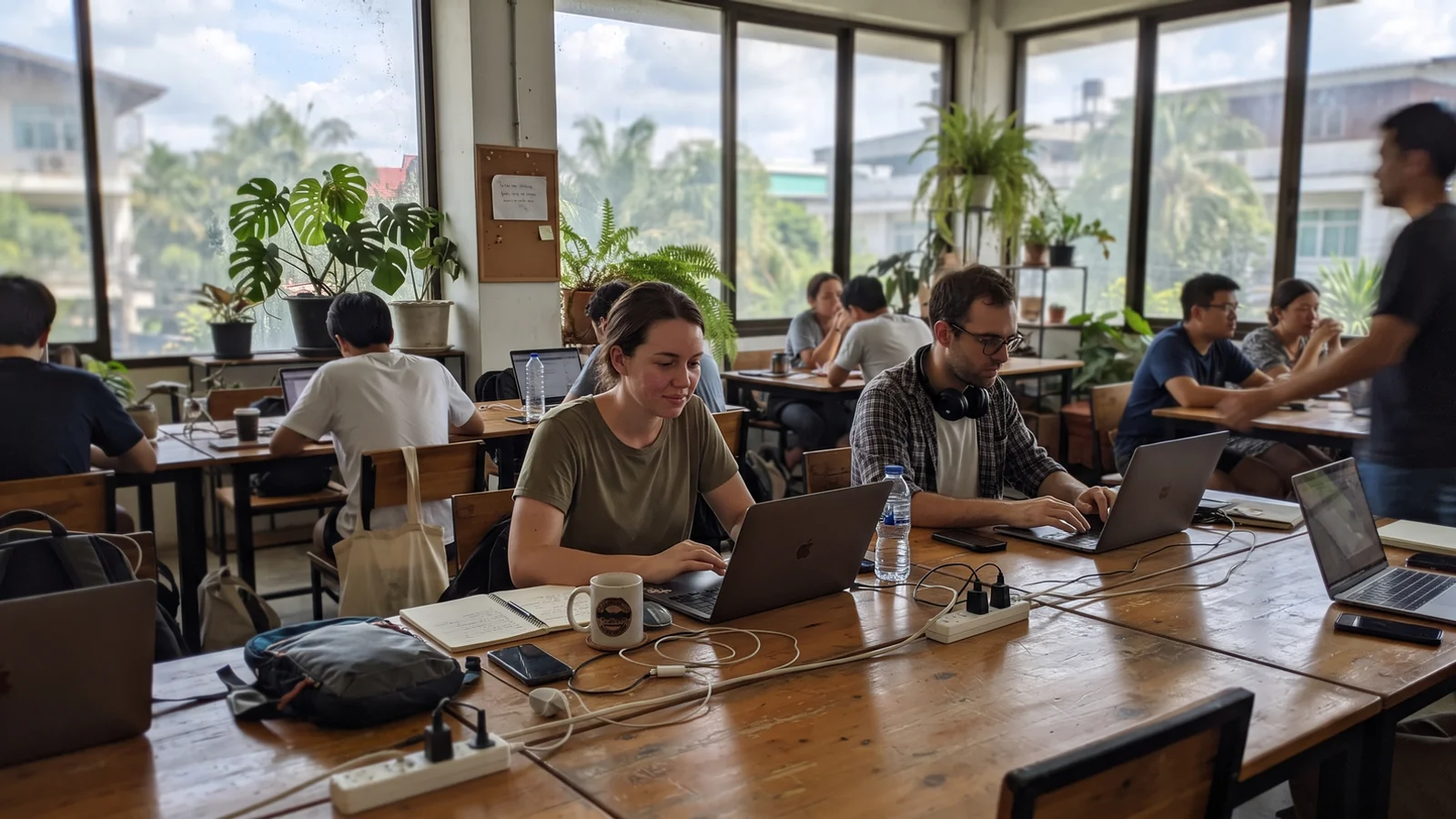
Chiang Mai’s reputation as a remote-work city is over a decade old, and the infrastructure has matured rather than faded. Fibre is fast and cheap, coworking spaces are plentiful and competitively priced, and the café culture has adapted to laptops without becoming hostile to them.
What has changed is the shape of the community. There are fewer people passing through for a month and more people staying for years, which means better long-term options: annual coworking memberships, proper desk setups, and a professional network that isn’t entirely made up of people who arrived last week.
The city’s spaces divide roughly into three types.
Community-first spaces like Yellow Coworking and Hub53 put events, talks and introductions at the centre. If you’re new to the city and want to meet people quickly, start here.
Function-first spaces like Punspace (Tha Phae / Wiang Kaew) optimise for quiet, air conditioning, reliable connections and a desk you can sit at for eight hours. Less networking, more output.
Live-work hybrids like Alt_ChiangMai bundle accommodation and workspace, which suits shorter stays where you’d rather not sign a lease.
Then there’s CAMP (Maya), the 24-hour study-and-work space on the top floor of the Maya mall. It’s free with a purchase, always busy, and the default answer when you need a desk at 2am for a call with New York.
Chiang Mai’s café scene is genuinely excellent, but not every café wants your laptop. The ones that do tend to advertise it: visible power sockets, larger tables, a stated Wi-Fi password on the menu.
The practical rule most residents settle on is to use cafés for two to three hours of focused work and coworking for full days and calls. Our work-friendly café guide lists the reliable options across Nimman and Santitham, including which ones have quiet corners and which get loud after 3pm.
Sort connectivity in this order:
If you take video calls for a living, the home connection is worth prioritising over a coworking membership. A good desk at home plus occasional day passes often beats a full monthly plan.
Guides
Every evergreen guide we've published on coworking & remote work in Chiang Mai.
Explainer
Chiang Mai's main coworking spaces — Yellow, Punspace, Alt_ChiangMai, Hub53 and more — with pass prices, Wi-Fi and community notes.
6 min read
Scenario
Cafés in Nimman and Santitham that genuinely support laptop work — Wi-Fi speed, plugs, noise, seating and long-stay etiquette.
5 min read
Step by step
Set up connectivity in Chiang Mai — SIM/eSIM options, home fibre, pocket Wi-Fi and backup plans for when the connection drops.
5 min read
Got questions?
Keep exploring
Newsletter
Twice a month: new openings, events, changes worth knowing about, and our latest guides. No filler.

The Chiang Mai Brief
Twice a month we send the openings, changes and guides worth knowing about. It takes two minutes to read.