Seasonal
Do You Need a Dehumidifier in Chiang Mai?
Chiang Mai's rainy season pushes indoor humidity well above comfortable levels. Here's how to tell if your space needs a dehumidifier.
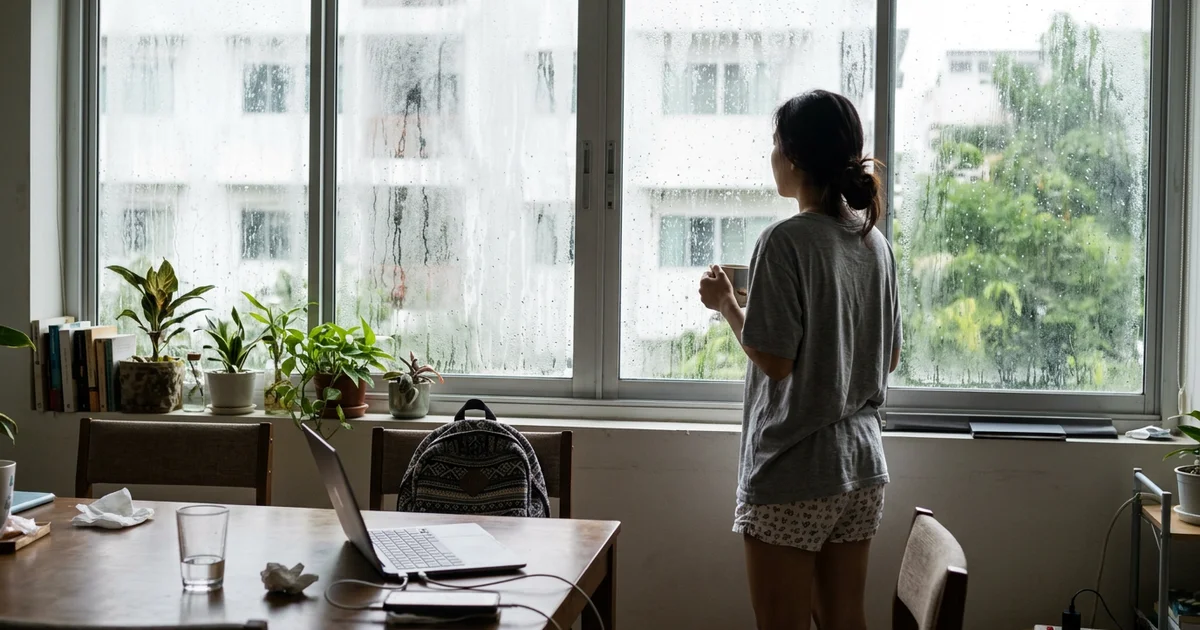
We often find that managing indoor air quality in Northern Thailand feels like a moving target.
The question of whether you need a dehumidifier in Chiang Mai comes up constantly as the dry season ends. Most of the year, the local humidity remains quite manageable. The hot season is uncomfortable, but you are primarily dealing with heat rather than moisture.
Our experience shows that the rainy season changes the equation entirely. From roughly May through October, outdoor humidity climbs well above 80 percent. Indoor levels will quickly follow suit unless your condo is unusually well-sealed.
The data reveals a clear picture of what is actually happening, and we can explore practical ways to respond.
How Chiang Mai’s rainy season affects indoor humidity
The rainy season directly drives indoor humidity up because air conditioners are optimized for temperature, not moisture extraction. When your room reaches your set temperature, the cooling compressor simply stops running.
Our team notes a major catch with this process during the wettest months. If you are running the AC lightly to save on electricity, the ambient moisture will quickly creep back up.
Data from recent climate models shows August and September in Chiang Mai average an 81 percent relative humidity.
On a wet day during these months, a room might sit at a comfortable 26°C but still show 75 percent indoor humidity.
We see this create a compounding issue for long-term residents. For short stays or people who run their AC constantly, this excess moisture rarely matters. For people living here through the full rainy season, the dampness quietly adds up.
Signs your space is too humid
The clearest signs of excess humidity are prolonged drying times for laundry and visible condensation on hard surfaces. These are the most common indicators to watch for in your condo:
- Towels and clothes hung indoors take more than 12 hours to dry.
- Condensation appears on windows or tiled surfaces in the mornings.
- A faint musty smell you cannot trace to anything specific.
- Mold appearing in bathroom grout, on window frames, or in floor-level corners.
- Leather goods, books, or electronics showing visible signs of moisture damage.
- Wooden fixtures like teak doors swelling and becoming difficult to close.
Our assessments show that high humidity damages specific materials very quickly. Environmental preservation data from 2026 indicates that mold can form on leather bags or shoes within 48 to 72 hours when humidity exceeds 70 percent.
A single symptom on its own does not mean much. Two or more consistently suggest the moisture in your space is staying above the comfortable range.
What comfortable indoor humidity actually means
Comfortable indoor humidity means maintaining the air between 30 and 50 percent of its maximum moisture capacity. Relative humidity (RH) represents this exact measurement as a clear percentage.
Our preferred baseline aligns with the 2026 American Society of Heating, Refrigerating and Air-Conditioning Engineers (ASHRAE) consensus. The organization recommends maintaining indoor environments in that 30 to 50 percent range for optimal health.
| Relative Humidity (RH) | Impact on Indoor Environment |
|---|---|
| 30% to 50% | ASHRAE recommended zone for optimal comfort and health. |
| Above 65% | Air feels noticeably sticky; condensation forms on cool surfaces. |
| Above 70% | Threshold where mold germinates readily on walls and leather. |
These ranges appear consistently across modern building and health guidance. They serve as a highly useful practical target rather than an arbitrary number.
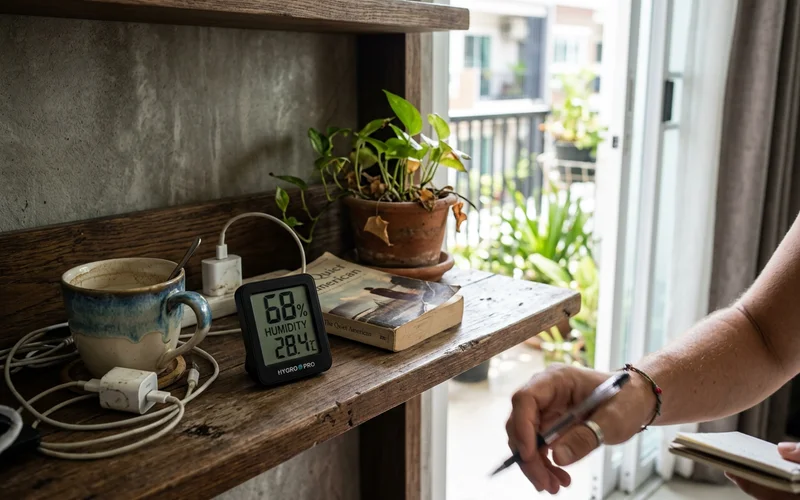
We highly recommend buying a basic digital hygrometer as your first step. Popular brands like Xiaomi offer reliable models on local e-commerce apps like Shopee for under 300 THB. Without a meter, you are relying purely on how things feel, which is very difficult to interpret precisely.
When a dehumidifier actually helps
A dehumidifier helps immensely if your hygrometer consistently shows above 65 percent relative humidity despite normal air conditioning use. It extracts moisture without chilling the air, keeping your environment dry even when the cooling compressor stops.
We find these units most useful in specific living scenarios:
- You are living in Northern Thailand through the full wet season, rather than just passing through.
- Your condo has limited natural ventilation and stays sticky despite regular cooling.
- You work from home and spend the majority of your day indoors.
- Mold keeps reappearing on leather goods or walls despite regular cleaning.
You probably do not need one if you are leaving the country before October. If your AC handles the moisture adequately already, you can skip the purchase.
What to look for when choosing one
You should prioritize extraction capacity, continuous drainage options, and energy efficiency when selecting a unit. A few practical factors will determine the best machine for your specific space.
Essential Buying Criteria
Capacity is always measured in liters per day. For a typical one-bedroom condo of 30 to 50 square meters, a unit rated at 10 to 12 liters per day is usually sufficient. Larger spaces will require more extraction capacity.
Our clients often overlook the difference between water tanks and continuous drainage. Most portable units collect extracted water in an internal bucket that you must empty manually. A unit with a continuous hose drainage option routed to a bathroom drain offers much more convenience for long-term use.
Operational Considerations
Noise levels matter because these machines run an internal compressor. The sound is comparable to a quiet refrigerator. Check the decibel rating carefully if you plan to run it in the bedroom overnight.
Energy use directly impacts your monthly expenses. Thailand’s residential electricity rates in 2026 average around 3.86 to 4.15 THB per kilowatt-hour, but many apartment landlords charge a flat 7 or 8 THB surcharge. Look closely at the wattage rating to estimate your monthly running costs.
Fan speeds offer necessary flexibility for daily use. Multiple settings let you run the machine quietly at night and more powerfully after a wet afternoon.
The relationship between AC and a dehumidifier
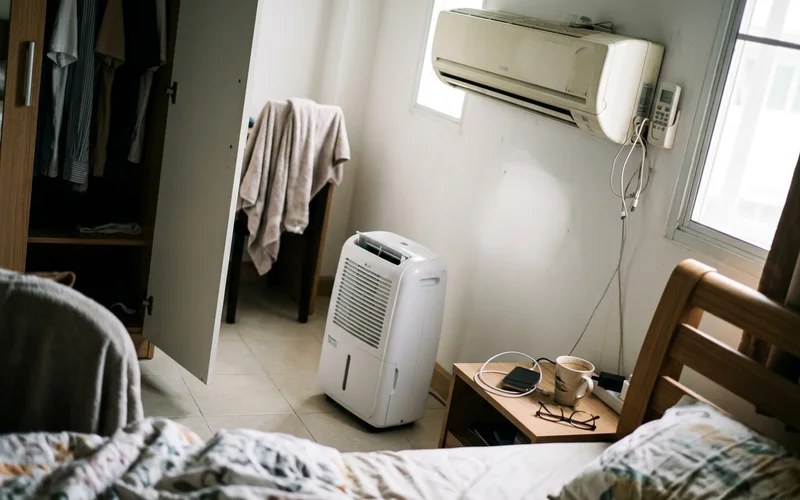
An air conditioner lowers the room temperature, while a dehumidifier specifically extracts moisture from the air. The two appliances perform entirely different functions and do not replace one another.
Our preferred strategy is running both together during the wettest months. You can keep the AC at a comfortable temperature while the standalone unit handles the residual moisture.
| Air Conditioning | Dehumidifier |
|---|---|
| Optimized to lower room temperature. | Optimized to extract moisture from the air. |
| Compressor stops when target temperature is reached. | Compressor runs continuously until the target humidity is reached. |
Lower moisture levels actually change how the air feels on your skin, allowing many people to set their AC slightly warmer. Setting your AC to a colder temperature is simply not the same as controlling indoor moisture. If your AC cycles off frequently and stickiness climbs back up between cycles, no amount of thermostat adjustment will fix that problem.
Making the call for your condo
Your decision ultimately comes down to the length of your stay and the specific ventilation of your building. Measuring your actual room conditions with a hygrometer is the only way to know for sure.
Our most practical advice is to get a hygrometer first before making any major appliance purchases. A well-sealed modern Nimman high-rise behaves entirely differently from an older Santitham shophouse with plenty of natural air movement.
Season length matters heavily too. If you are leaving the city by September, your exposure window is much shorter. If you are consistently above 70 percent despite normal AC use, do you need a dehumidifier in Chiang Mai?
The answer is a definitive yes. People who make the purchase tend to report that the impact is much bigger than expected. The reduction in moisture improves everyday physical comfort just as much as it reduces the risk of mold.

The Chiang Mai Brief Editorial Team
Editorial Team
The Chiang Mai Brief publishes practical, independent guides to living in and visiting Chiang Mai. We cover neighbourhoods, food, transport, accommodation, events and the practical details that help readers get more from the city.
Independent English-language Chiang Mai publication